Invitation to the book presentation and discussion “Explaining Economic Backwardness. Post-1945 Polish Historians on Eastern Europe”
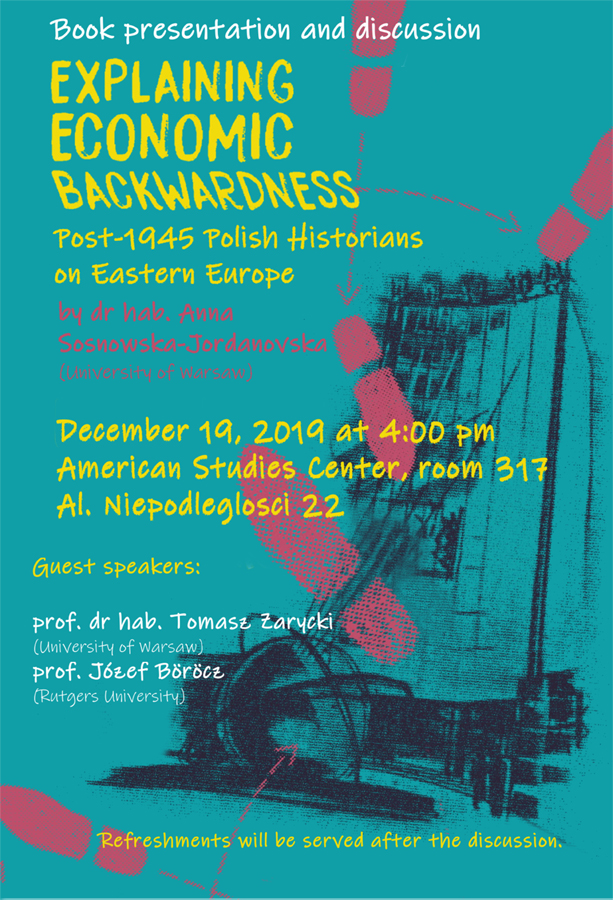
We are pleased to announce the book presentation and discussion:
“Explaining Economic Backwardness. Post-1945 Polish Historians on Eastern Europe”
(Central European University Press 2019) by dr hab. Anna Sosnowska-Jordanovska (University of Warsaw)
Guest speakers:
prof. dr hab. Tomasz Zarycki (University of Warsaw)
prof. Józef Böröcz (Rutgers University)
December 19, 2019 at 4:00 pm
American Studies Center, room 317
Refreshments will be served after the discussion.
ABSTRACT
The book presents an exciting episode in the intellectual history of Europe: the vigorous debate among leading Polish historians on the sources of the economic development and non-development, including the origins of economic divisions within Europe. The monograph covers nearly fifty years of this debate between the publication of two pivotal works in 1947 and 1994.
Anna Sosnowska provides an insightful interpretation of how local and generational experience shaped the notions of post-1945 Polish historians about Eastern European backwardness, and how their debate influenced Western historical sociology, social theories of development and dependency in peripheral areas, and the image of Eastern Europe in Western, Marxist-inspired social science. Although created under the adverse conditions of state socialism and censorship, this body of scholarship had an important repercussion in international social science of the post-war period, contributing an emphasis on international comparisons, as well as a stress on social theory and explanations. Sosnowska’s analysis also helps to understand current differences that lead to conflicts between Europe’s richest and economically most developed core and its southern and eastern peripheries. The historians she studies also investigated analogies between paths in Eastern Europe and regions of West Africa, Latin America and East Asia.
More details: http://ceupress.com/book/explaining-economic-backwardness
BIO
Anna Sosnowska is a sociologist and an associate professor at the American Studies Center. Her research focuses on the impact of migrations from Eastern Europe and other world’s peripheries on the American cities in the post-industrial era. She is an author of the books: Zrozumieć zacofanie. Spory historyków o Europę Wschodnią (1947-1994), TRIO 2004 and Polski Greenpoint a Nowy Jork. Gentryfikacja, stosunki etniczne i imigrancki rynek pracy na przełomie XX i XXI wieku, Wydawnictwo Naukowe SCHOLAR 2016. She recently published Polish Female Immigrant Niche in Studia Migracyjne-Przegląd Polonijny 2017 and Explaining Economic Backwardness. Post-1945 Polish Historians on Eastern Europe, Central European University Press 2019.
Tomasz Zarycki is a sociologist and social geographer currently holding the position of the Director of Institute for Social Studies (University of Warsaw). He is specializing in sociology of politics, sociology of culture, sociology of knowledge, critical sociology and discourse analysis with particular focus on Polish and Eastern European societies. His books include Ideologies of Eastness in Central and Eastern Europe (Routledge, 2014), Peryferie. Nowe ujęcia zależności centro–peryferyjnych (Scholar, 2009), Kapitał kulturowy. Inteligencja w Polsce i Rosji (Wydawnictwa Uniwersytetu Warszawskiego 2008), New Regional Identities and Strategic Essentialism. Case studies from Poland, Italy and Germany (co-author, Münster: LIT Verlag, 2007), „Region jako kontekst zachowań politycznych”, (Scholar 2002). His articles appeared in such journals as Current Sociology, Communist and Post-Communist Studies, East European Politics and Societies, Europe-Asia Studies, GeoForum, Journal of Communist Studies and Transition Politics, Kultura i Społeczeństwo, Russian Education & Society, Theory and Society, and several others.
Józef Böröcz is a sociologist, currently Professor of Sociology at Rutgers University. His interests include narrative and visual sociologies of historical experiences, politics and performing arts, knowledge and otherness, large-scale (indeed global) transformations, and intersections of political economy, geopolitics, coloniality, ethics, aesthetics and power. He is the author of The European Union and Global Social Change: A Critical Geopolitical Economic Analysis (Routledge, UK, 2009, also published in Hungarian, Kalligram 2018), Hasított fa: A világrendszerelmélettől a globális struktúraváltásokig (l’Harmattan, 2017) Leisure Migration: A Sociological Study on Tourism (Pergamon Press, 1996), co-editor of and contributor to three collections: El ultimo europeo: Imperialismo, xenofobia y derecha radical en la Unión Europea (Madrid: La oveja roja, 2014) and Empire’s New Clothes: Unveiling EU-Enlargement, (published by the online journal Central Europe Review, 2001), A New World Order? Global Transformation in the Late 20th Century (Greenwood Press, 1995), and Gender and Nation (a Special Block in the journal East European Politics and Societies). His most recent journal publications include “Performing socialist Hungary in China: ‘modern, Magyar, European’.” Cold War History, 2018, 2 (April 30) and (with Mahua Sarkar): “The Unbearable Whiteness of the Polish Plumber and the Hungarian ‘Peacock Dance’ Around ‘Race’.” Slavic Review. 76, 2 (Summer 2017).