The Worlds of the Slavs: Market Towns and Trade from the Elbe to the Yenisei (10th-15th centuries)
The Tadeusz Manteuffel Institute of History Polish Academy of Sciences
The Polish Young Academy of the Polish Academy of Sciences
Centre for East European Studies University of Warsaw
Oxford Centre for Byzantine Research
Early Slavonic Research Seminar
Institute of Central Europe
Institute of Archaeology and Ethnography Polish Academy of Sciences
We cordially invite you to the second in a series of conferences on the theme
‘Worlds of the Slavs’
‘Market Towns and Trade from the Elbe to the Yenisei (10th-15th centuries)’
Warsaw (September 15-17, 2022)
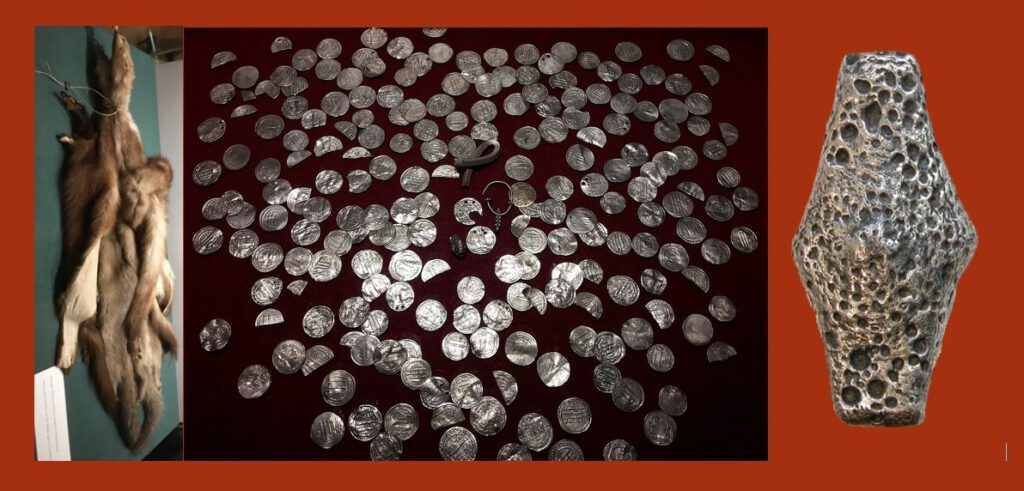
On the behalf of the Organizing Committee we would like to invite to participation in the Second hybrid (traditional and on-line way) Conference “Worlds of the Slavs”
Trade, apart from purely economic aspects, has always contributed to the development of far-reaching connections and broadly understood intercultural communication. Transport and exchange of goods, i.e. the wandering of things, has always brought with it also the wandering of people, knowledge and ideas. The region from the Elbe to the Yenisei was inhabited in the Middle Ages by various cultural communities what made of it huge, but interconnected thanks to the far-reaching exchange, meeting place. The representatives of sophisticated civilizations (Byzantine, Latin, Arab), as well as the “barbarian” Scandinavians, the Slavs dominating in the Central and East European lowlands, the Great Steppe nomads, the Baltic and Finno-Ugric inhabitants of the northern parts of the European continent were involved in the far-reaching trade. The participation of these worlds varied greatly: from organizing a long-range exchange to becoming its cargo. The trade, especially long-distance, was also state-creating factor. The early states’ rulers sought to take control of trade and monopolize the prerogatives allowing for its organization and ensuring the security of trade exchange. The income to the treasury thus obtained strengthened the position of the rulers of the newly established states. The attempt of local rulers to maximize the profit from trade exchange has also paved the way to the monetization of economic relations in a part of the region we are interested in.
Topics of interest include (but are not limited to):
- the functioning of emporia and other places of trade exchange;
- the formation of long-distance routes and factors determining their course;
- intercultural exchange through trade;
- the role of rulers in creating trade exchange and their efforts to control it;
- metal money and commodity money as an exchange device;
- economic meaning of the hoards;
- the role of trade in creating settlement net (strongholds and cities);
- the influence of the law on the trade;
- reflection/traces of trade in urban infrastructure;
- the influence of trade on the conceptualization and understanding of geographical space;
- the place of people involved in commodity exchange in their cultural communities;
- measures and weights in trade;
- trade route in the written sources;
- trade in goods of supra-local importance (salt, silk, leather, furs, slaves, etc.);
- trade organizations.
Conference applications (download the file: Application for participation) with abstracts and consent to the processing of personal data (download the file: Processing personal data) should be submitted by 28 February 2022 to the following address: theworldoftheslavs@gmail.com. The conference languages will be Polish, Russian and English. The organizers will provide accommodation.
Organizing Committee: Florin Curta (coordinator, Florida, USA), Marta Font (coordinator, Pécs, Hungary), Marek Jankowiak (coordinator, Oxford, United Kingdom), Adrian Jusupović (main coordinator, Warsaw, Poland), Aleksander Paroń (coordinator, Wrocław, Poland), Jonathan Shepard (coordinator, Oxford/Cambridge, United Kingdom), Aleksandra Vukovich (coordinator, Oxford, United Kingdom).
 Application for participation