The Worlds of the Slavs: Food in the Worlds of the Slavs up to the 16th century
The Tadeusz Manteuffel Institute of History Polish Academy of Sciences
The Polish Young Academy of the Polish Academy of Sciences
Committee of Slavic Studies of Polish Academy of Sciences
Oxford Centre for Byzantine Research
King’s College London
We cordially invite you to the third in a series of conferences on the theme
‘Worlds of the Slavs’
Food in the Worlds of the Slavs up to the 16th century
Warsaw
September 18–20, 2024
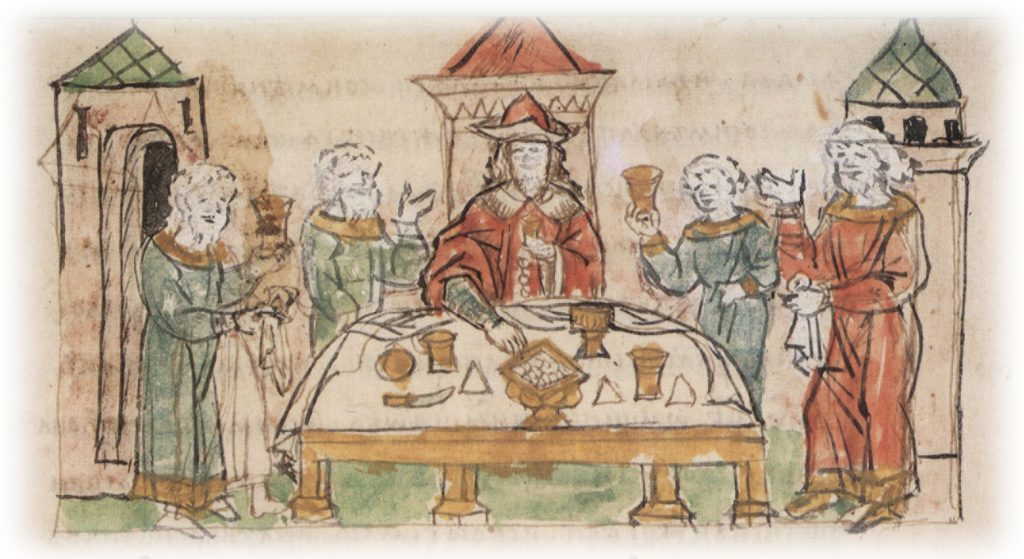
A common dinner of Iziaslav Yaroslavich of Kiev, Sviatoslav Iaroslavich of Chernigov and Vsevolod Yaroslavich of Pereyaslavl with his boyars after the festive liturgy. From website: https://runivers.ru/doc/rusland/letopisi/?SECTION_ID=19639&ELEMENT_ID=587056
The Slavonic-speaking region was a meeting place for various cultures and this is reflected in food production and eating habits. Food is clearly an essential part of everyday life. But besides the strictly biological, and closely related economic, dimensions of producing and selling food, there is also a symbolic, imagined one. These dimensions are reflected in various source categories: we find traces of the Slavs’ dietary habits not only in written sources like annals, chronicles, birch barks manuscripts, but also in material culture through art, archaeology, palynology and archaeozoology. These sources illustrate the symbolic and the material dimensions of food in Slav societies. In the early period, they were often inseparable: food consumption and production were subject to secular but also to canonical legislation and various religious customs and taboos (including non-Christian ones). In an emergency (war, famine, or elemental disaster), normative restrictions could be suspended or pragmatically circumvented. The social mobility which followed an increase in trade and travel led to the adoption of alien dietary habits and modification of one’s own. These customs may also have been, consciously or unconsciously, a means of discovering and creating identity: an important element in recognizing (and demarcating) the stranger, in strengthening interactions between communities, or in consolidating the rules of one’s own. At the conference, we welcome contributions on issues such as:
- Food production and changes in food production;
- Food as tribute;
- The ritual, symbolic, and magical dimensions of food;
- Long-distance and local food trade;
- Legal regulation of food production, trade, and consumption;
- Food storage practices;
- Reflections (medieval and modern) on healthy eating;
- War, famine, and environmental disasters and their impact on food habits;
- Perceptions of one’s own and others’ eating habits; food as an element of identity; migration of eating habits;
- Unusual eating habits; and
- Food practices in folklore.
Conference applications should be submitted by 28 February 2024: https://docs.google.com/forms/
The conference languages will be English and Polish. The organizers will provide accommodation.
Should you have any further questions please do not hesitate to contact us at: theworldoftheslavs@gmail.com.
Organizing Committee: Marta Font (coordinator, Pécs, Hungary), Adrian Jusupović (main coordinator, Warsaw, Poland), Aleksander Paroń (coordinator, Wrocław, Poland), Jonathan Shepard (coordinator, Oxford/Cambridge, United Kingdom), Monika Stobiecka (main coordinator, Warsaw, Poland), Alexandra Vukovich (coordinator, King’s College London, United Kingdom).